
The Midnight: Memory, Myth & Neon.
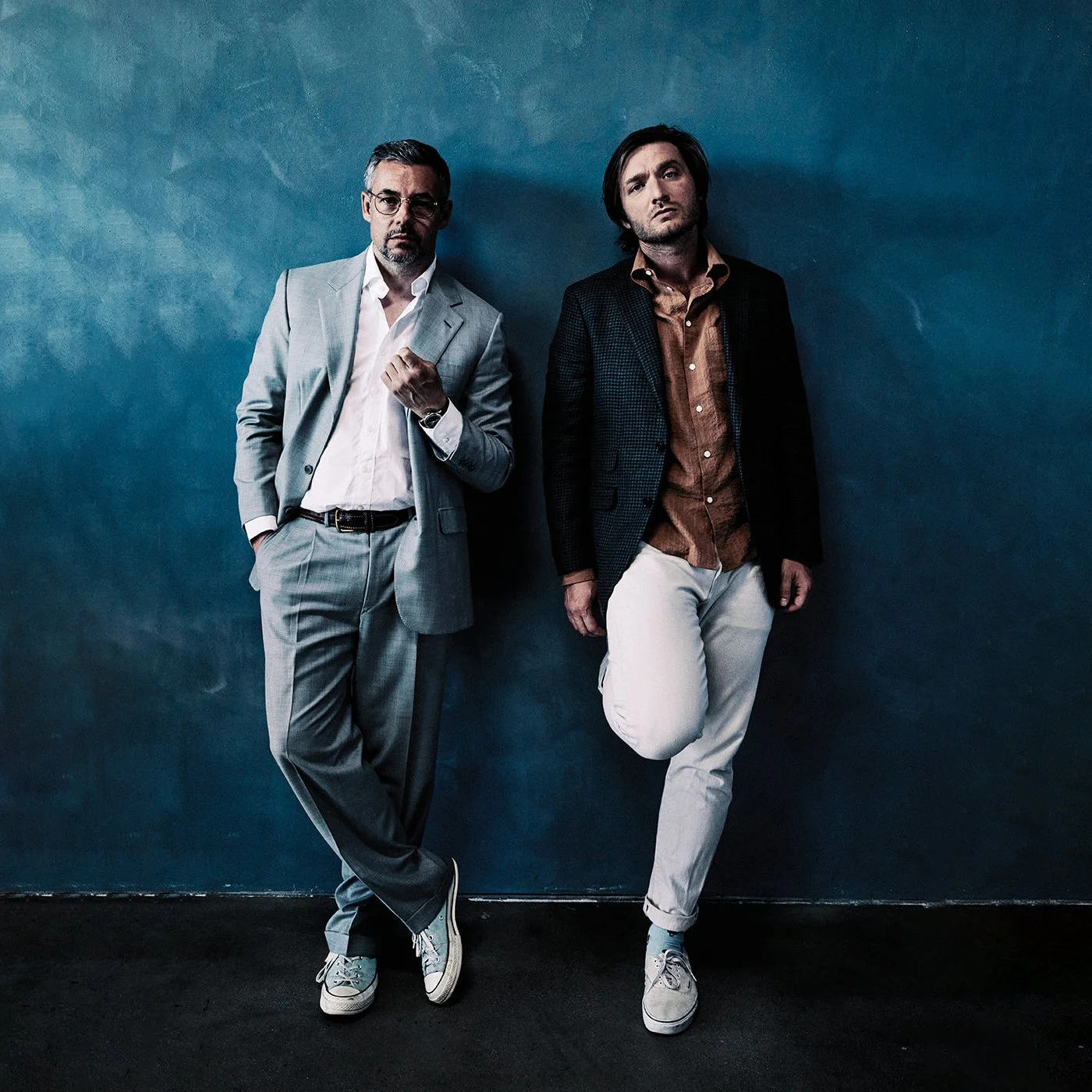
L-R: Tim McEwan, Tyler Lyle. Photography by Jimmy Fontaine.
US-based synthwave duo The Midnight are Tyler Lyle and Tim McEwan. Having met at a songwriting workshop, they began working together in 2012, recording their debut EP in 2014. Their sixth album, Syndicate, was released in October 2025.
For the first few years of The Midnight, it was a side project to their individual careers – Lyle as a solo artist and McEwan as a producer – until the success of their first LP, Endless Summer, in 2016 saw their priorities shift. “That was the year where Tim and I decided that this was going to be our thing, that we were going to be 50/50 partners in this thing, and we were going to try to do right by it,” Lyle says, recalling the excitement of emerging from a cinema on the evening of the album’s release to see the Bandcamp sales stacking up. But it was only with their first live show the following year that things properly took off. “Endless Summer was the match meeting the fuse. It didn't really explode until the next year when we thought, ‘Oh, we're a live band, and this is going to be our job.’”
McEwan agrees that their debut gig in July 2017, at the DNA Lounge in San Francisco, was the turning point: “We barely knew what we were doing and how we were going to execute this thing live. This guy from San Francisco had messaged us on Facebook for probably a year, but we couldn't even see how that would make sense financially.” It wasn't until the promoter suggested a co-headline with FM-84 that they decided to take the plunge, though with little expectation of making any money from it. Together with experienced saxophone player Jesse Malloy, who had paid for his own travel and accommodation, they arrived at the venue to find a queue of fans waiting for admission – the online community that had been slowly building for the past couple of years was standing before them. “I remember seeing this line and, like an idiot, going, ‘Oh, I wonder who's playing?’ Then I saw the Midnight T-shirts, and that's when the penny dropped.”
The Midnight continue to be sustained by the synthwave community, and they enjoy the music of fellow artists such as FM-84 and their regular collaborator Timecop1983. “We’re all a bunch of bedroom producers, that’s how we all started. We’re all a bunch of creative weirdos who like doing weird niche stuff. It attracts all of us outsiders that maybe weren't the coolest people when we were young,” McEwan says. “A lot of our fan base find their tribe online.” He credits them with creating a welcoming and tolerant atmosphere. “People will come to shows not having any friends and then leave having made friends. I see it online: people invite each other to pre-show gatherings at a nearby bar, or an arcade, or something. I love how inclusive and kind this scene is.” While some critics have characterized synthwave as 80s nostalgia, Lyle sees it differently. “I think of The Midnight as less of an 80s band and more of a meta-commentary on what genre means in different iterations. There's memory and the ephemera of childhood – the toys you played with as a kid, what TVs looked like, the actual memory. But synthwave to me is more of the dream, it's the mythology, it's the primordial cave of childhood. The imagined 80s is much richer and more interesting than the remembered 80s.”
“We’ve both been through lots of different life changes in the last couple of years, we had come out on the other side, and as a result have been stronger creatively for it”
Syndicate is The Midnight’s first album for their new label, and the breathing room Ultra Records gave the band bodes well for their future working relationship, as Lyle explains. “We made some really cool songs, but by the end of it, we thought, ‘We're not finished, let's open the book up again and tell the best story we can.’ Usually, at least since Nocturnal, we've been on deadlines to release things. The last part of the creative process is combing through a 99% finished work and going, ‘You know what, we could punch this up, and punch this up,’ and having that finishing phase has been helpful. This is the first time that we've been able to take some extra time and write a few extra songs, and feel we captured all the things that we were going for – we got the heart in it, finally.”
As a result, the album has 17 tracks over a running time of 85 minutes. “It ended up being such a long album not by design or choice – just this was the story we felt we had to tell,” McEwan says. “I think the goal for both of us was to make a really defining album. “We’ve both been through lots of different life changes in the last couple of years, we had come out on the other side, and as a result have been stronger creatively for it.” By finding what he describes as a new iteration of their core sound, Syndicate stays true to their roots while looking resolutely to the future. “Everything felt very intentional, and seeing how it landed with the core fan base and the newcomers too was very affirming.”
As lead vocalist, Lyle takes the frontman role while producer McEwan is in charge in the studio, but writing credits are shared equally. The origins of the album track “Quiet Earth” were in an instrumental by McEwan. “I was playing around with some new synths I got, and there's some DX7 in there, and some Oberheim Matrix 6, which is a vintage synth from the 80s. I was wanting to make a mood piece. It's a kindred spirit to something like ‘Tokyo Night Train’ from Nocturnal, or something in that world.” Following the death of his Shih Tzu, Winston, McEwan had written some verses inspired by Clare Harner’s 1934 poem “Immortality” (“Do not stand by my grave and weep”). “It was Tyler's idea to intersperse that into ‘Quiet Earth’ and make it part of the thing, so that's how that came about.”
It’s followed on the album by “Long Island”, based on a solo demo by Lyle that dates back to 2015. “I wrote a song called ‘Four Roses’ about the struggle of an artist living in New York City. A lot of it is based on Patti Smith's book Just Kids – this young Dionysian spirit of freedom. At some point, that unstoppable force meets the immovable object of adulthood, and you have to grow up. That's the tragedy at the end of every story about an artist.” As a response to that dilemma, he wrote the song as a dialogue between two characters representing the two islands of New York: Long Island (family life, adulthood) and Manhattan (art, freedom). “It's told as a romance between two people, but it's the two halves of my soul at the time.”
McEwan decided that a simple production style would be best for such a personal song. “There are a couple of these songs where my job, I feel, is to get out of the way and create a space for Tyler's voice to sit and tell the story. So, I tried to honestly do less with it. It's not about the big drop or the crazy vocal sample – I love doing that stuff, but it's not for everything. We do have a bit of that duality in The Midnight where there is that production-heavy side, but then there’s also that very clear singer-songwriter world where I think it's more tasteful to get out of the way.” Again, they found inspiration in their past work, McEwan unearthing his remix of Jon Bellion’s “80’s Films”. “I never made any money off it because we never sold it, it was never an official remix, it was just this fun exercise. It had this little melody, which is the theme you hear in ‘Long Island’. I love the lyrics, and I love Tyler's vocals on that, so I tried to wrap my world around it and let it support the story.”
Autumn 2025 saw The Midnight tour extensively around Europe, and McEwan describes the live reaction to the new material as “really gratifying and such an amazing experience.” They are kicking off 2026 with shows in Asia and Australia before taking a break from performing for a couple of months. While both struggle with the rigours of touring and Lyle is conscious of having missed months of his child’s life while on the road, they both agree that it’s a fair trade for the privilege of making a living from music. And the appreciation from the audience always makes it worthwhile, as McEwan explains. “The fan base for synthwave, they're so stoked to be there, and that this is happening. When you give them a couple of hours to live that dream, they go nuts for it, and we feel that – we feel that energy on stage.”
Author: Rachel Goodyear