
Jake Bugg: Exploring the Sound of ‘ALAMO’
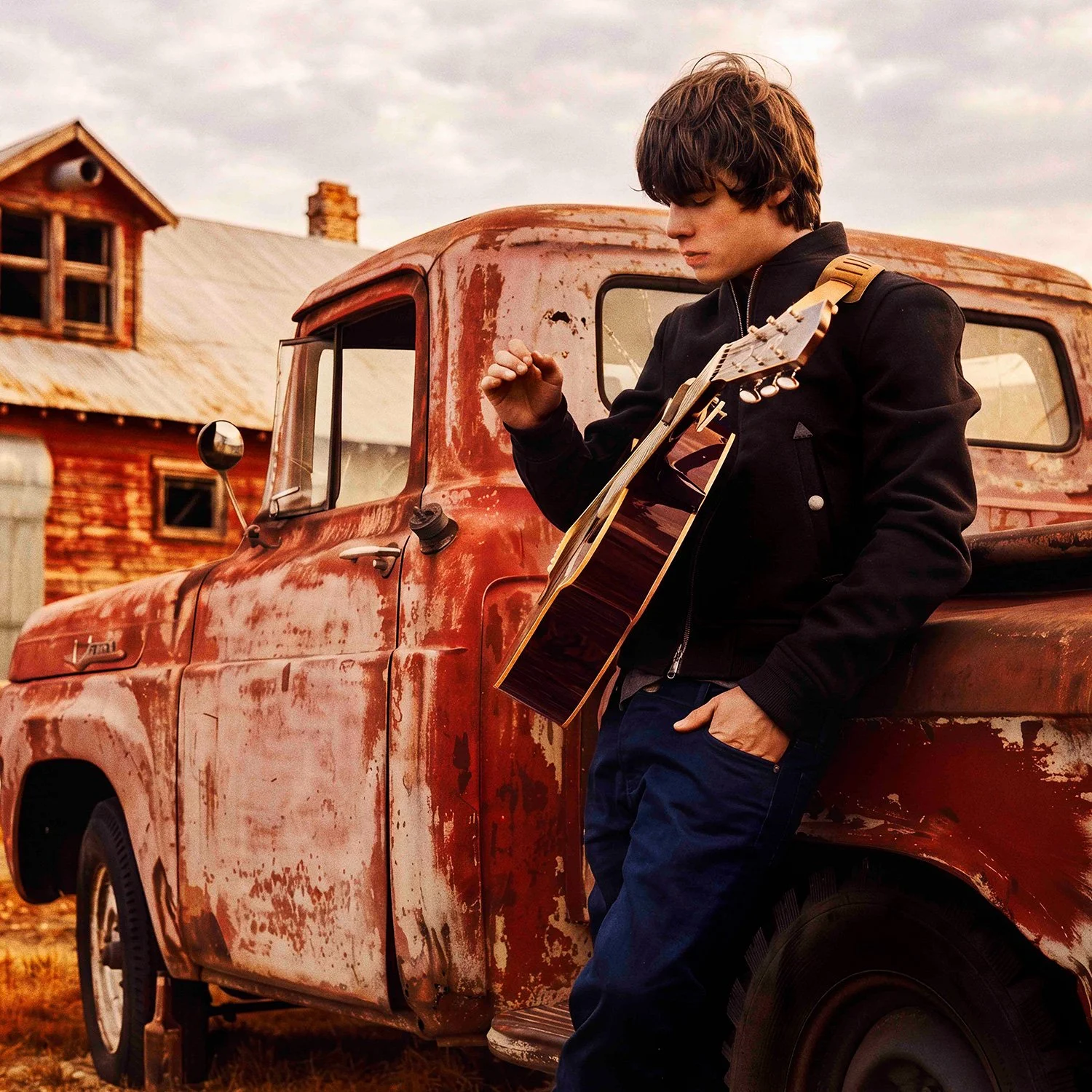
Photography: Kevin Westenberg.
At the age of eighteen, Nottingham-born singer-songwriter and guitarist Jake Bugg released his self-titled debut album, which went straight to the top of the UK album chart and earned him a Mercury Prize nomination. Over the following fifteen years, his critically acclaimed music has continued to reach a wide audience, featuring on TV and film soundtracks as well as best-selling records. His seventh studio album, Alamo, launches this month with 20 in-store performances, which will be followed by a tour of the UK and Ireland in early 2027.
In a reversal of the usual progression, Bugg started out on major labels but has now moved to an independent. Although he never felt creatively hobbled by being with a major, he finds the lack of behind-the-scenes politics at his new label refreshing. “I understand major labels have to make their returns and they have to make the money to keep going. But I think sometimes in the midst of it, especially in this climate, the music becomes a little bit secondary to it all, which was something I was kind of struggling with.” A significant hurdle for Bugg was the pressure to constantly self-promote online. “It's something I'm not very good at doing. And unfortunately, because everybody's doing it and releasing so much a day, then nothing really stands out. I feel really bad for upcoming artists – it feels like they have to spend more time doing the social side of it than writing the music and playing the music. And that's just not the way it should be: I just want to make records, I just want to be in the studio, and I want to play shows.” Alamo is his first album for Thirty Tigers, who he feels have freed him to focus on the music itself rather than pounding the social media treadmill. “My relationship with them has been fantastic, and to have that kind of excitement again, even to promote records and talk about it but not have to worry so much about what's happening behind the scenes, it's been great. I don't know why I didn't do it sooner.”
Alamo was co-created with his long-time friend Jimmy Hogarth and Grammy Award-winning songwriter Steve McEwan. The first song they wrote together, “Never Can Tell”, is an upbeat track that proved to be atypical of the album as a whole. “It makes sense that would be the first song, because you don't really get into the studio – especially as I'd not met Steve before – and be like, ‘Right, we're going to write a song called “The Life”, and it's going to be really dark and miserable’. Let's start with something a bit more fun and with a bit of energy, which is what we did.” Although he was pleased with the song, which was to become the lead single from Alamo, he didn’t believe it was the right direction for the rest of the album. “I was like, I want it to be a bit more personal. I want it to have a bit more depth about it and something more internal. And especially as the last record was so much about societal issues, from the perspective of being on the outside and looking in. I thought that this record was an opportunity to go the other way. It's something that's always been in me; I just hadn't ever been able to articulate it before. So this felt like the right time.”
The change of mood is exemplified by “Cloud in the Sky”, a solo composition which draws on difficult events in his life. “That was something I just wrote all at home; I didn't really share that writing experience with anybody else, which makes it even more personal, I think.” Unusually for Bugg, he wrote the lyrics before the music. “That's why the structure is very unconventional,” he says. “The second verse is longer than the first verse, and there's all these little things, like the chords change around because I'm playing to the words and that's something I found a little difficult.” In retrospect, Bugg sees the process of writing about tough experiences for Alamo as positive for both his art and his life, although he admits that he still finds the song upsetting. “It can be hard to hear it sometimes, but it does allow you to heal as well and process it a bit more. I think you don't really know how much of a bad place you can be in until you come out a little bit the other side. And I think the album’s kind of helped me to just acknowledge that and just be honest about it in a way that feels comfortable to me. And unfortunately, it's sometimes a fact that you have to go through a bit of pain for the art, you know. It's never fun, but at least I got a record out of it.”
“I think your mind’s kind of subconsciously trying to push something out there that you might not even be aware of. A lot of songwriters say that you don’t even realize what a song’s about sometimes until maybe a little bit further down the line”
While the first song Bugg wrote defined what the album would not be, the last song turned out to be the one that both named it and captured its character. “‘Alamo’ was the last track I wrote for the record, and that's why I chose the title. I always struggled to find an album title, and I felt like that was the song that kind of encapsulated all the other songs on the record.” For Bugg, the metaphor of life as a battlefield threads through the whole album. “You know, it feels like you're watching out for trip mines from all angles, and you're just looking for some way to navigate it to some sort of cover and some sort of safety. And that's kind of what each song is about, whether it's a relationship or isolation and what all those things can lead up to, and what situation you find yourself in.”
“Alamo” was also one of the tracks created through what Bugg calls “passive songwriting”. He explains: “I'd be in the studio all day. I'd come back, watch the football, pick up the guitar, and then just start playing and singing. And I wouldn't be conscious of what I was doing because I was watching the game. And then, if I found something good, obviously I'd turn the game down and record, do a voice memo, which is what I did for ‘Alamo’. And I think the melody and the guitar chords, that was probably about 10 minutes.” His theory is that by allowing a song to emerge almost automatically, he can access ideas and thoughts that might not surface through a more conventional songwriting technique. “I think your mind’s kind of subconsciously trying to push something out there that you might not even be aware of. A lot of songwriters say that you don't even realize what a song's about sometimes until maybe a little bit further down the line.” He then took “Alamo” into the studio to work on it with Hogarth and McEwan, where they opted for a minimalist production style. “I'm glad it turned out that way. It's just a couple of guitars and a bass and a bit of lap steel, which I think complements the story quite well.”
Alamo’s cover – a striking Kevin Westenberg photograph of Bugg, guitar slung across his back, walking away from the camera down a dusty road – evokes the album’s meditative mood as well as nodding to its folk and country influences. While the artwork for the majority of his foregoing albums featured Bugg’s face, according to received marketing wisdom, showing just the back of his head this time was a compromise between those commercial imperatives and his artistic sensibilities. “Some of my favourite album covers are kind of like Vangelis, who is my favourite artist.” This is a surprising admission from a musician inspired by singer-songwriters such as Bob Dylan, Leonard Cohen and Don McLean, but as a kid, he says, he didn't even like vocal music. “My mum and dad both sang, but I loved Vangelis’s music. It was just peaceful; I love the sound of the synthesiser. I always thought the artwork for a lot of those sort of artists was interesting, like Jean-Michel Jarre, Equinoxe, Oxygène and things like that. It was like those amazing psychedelic space-type artworks. Maybe in the future I'll do a bit more artwork – when I'm not as young anymore!”
While in Nashville to meet the Thirty Tigers team in person this autumn, Bugg also played his first American shows in a couple of years. “It was just a lot of fun,” he says. “Hopefully we can pick up a little bit more of an audience out there.” But he acknowledges the difficulty of making an impact in Music City, where top-tier artists are competing with each other for an audience every night. “As fun as the experience is, it can be a very humbling one for a musician as well. But I don't mind that. I mean, every day is for me about learning something new, especially when it comes to music. And the more you learn, the more you realize there's always another level. Just when you start thinking, ‘Oh, I might have the hang of this’, you discover there's many more levels to go.”
Alamo is released 13th November.
Author: Rachel Goodyear