
Johnny Marr Returns With The Age Of Everything
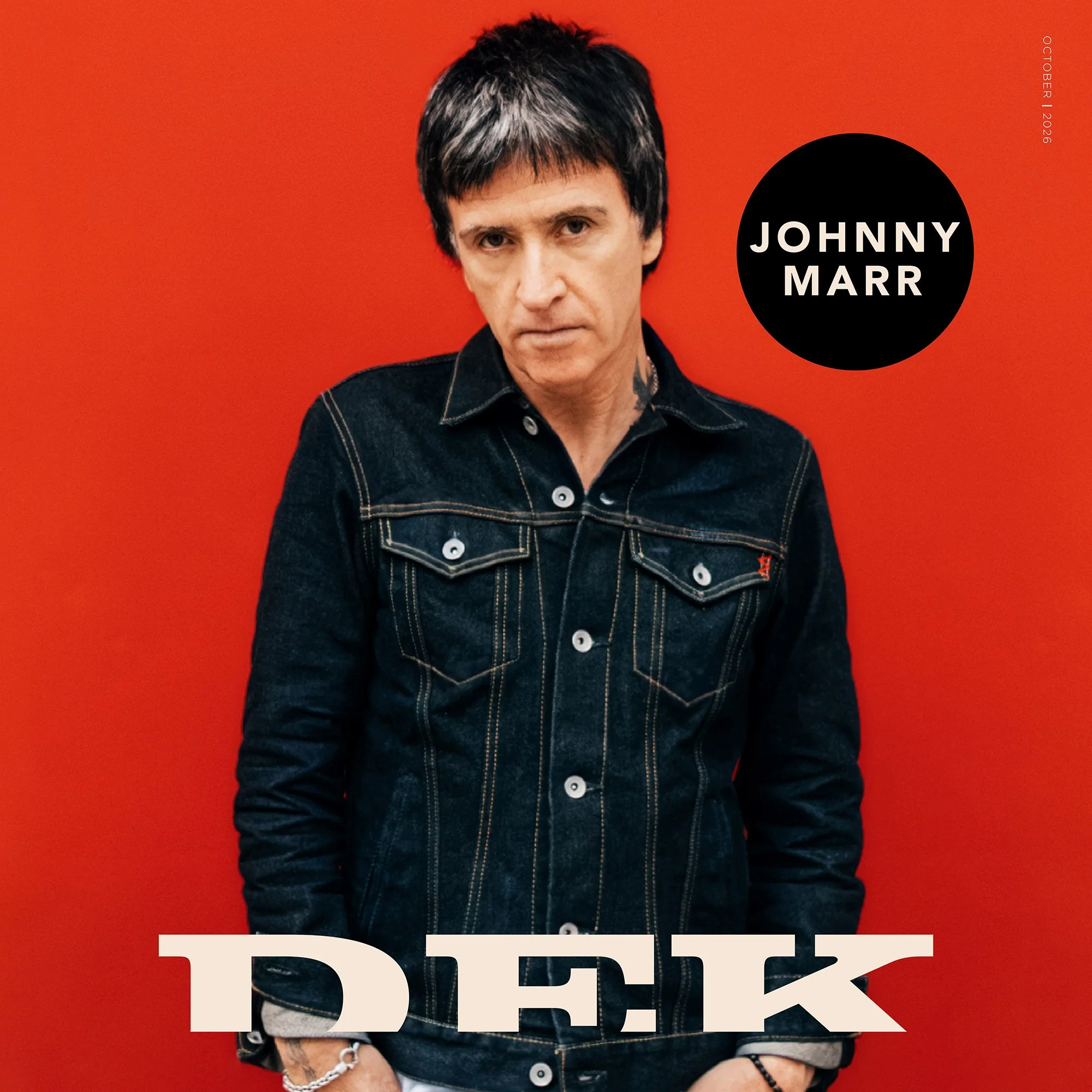
Photography: Gaëlle Beri.
Johnny Marr’s distinctive guitar sound has been part of the British musical landscape for over forty years. First coming to fame with The Smiths, he has gone on to have a successful solo career alongside collaborations with a diverse range of artists from Talking Heads to Billy Eilish, Hans Zimmer to Noel Gallagher, his achievements being recognized by an Ivor Novello Inspiration Award and NME Godlike Genius Award. This October he releases his fifth solo studio album, The Age of Everything.
Last autumn, before recording the album, Marr played the new material while on tour in North America and Europe – an unusual step these days. “People get a bit paranoid about the songs being out on YouTube and people hearing them before they’re finished,” he says, but he’s not bothered about that, instead prioritizing what’s best for the music. “I know the absolute benefit of getting out in front of an audience and finding out, ‘Oh, we’re actually playing that song way too slow. Oh, we’re playing that song a little bit too fast. Oh, that intro’s going around too long. That outro is shit. When I look down on stage and I see it in the middle of the set list, I don’t really like that title.’ You get really focused when you’re standing in front of a couple of thousand people, and they’ve never heard it before.”
As well as helping him to hone the songs, having taken them on the road first kept Marr motivated when he went into the studio on his return. He particularly remembered playing “Spin”, the opening track and first single to be released from the album, at Port Chester in New York. “There was a young woman about five feet away from me, and she acted like it was the greatest song she’d ever heard. You know, it was ecstatic. And that really gives you some wind in your sails when you’re in the studio back in Manchester on a winter’s morning.” The buzz of that immediate feedback recalled his early days in The Smiths: “Back then it was people of my own age and we’re playing in unis and little clubs, and the bar staff are in there setting up, and you play a song that isn’t even recorded yet. And you can feel the vibe in the room – people are really digging it. It just gives you real encouragement, and you know you’re on to the right thing.”
Marr is not content to sit back and reap the easy rewards of elder-statesman status, and The Age of Everything sees him challenging himself anew. The latest single, “It’s Time”, encapsulates the spirit of the album: a clear-eyed view of the contemporary moment that’s also full of defiance and optimism. “I’m always trying to get better,” says Marr. “Because the alternative would be resting on time-tested processes, and I think most songwriters will tell you that if you’ve had success with a song, you’re never able to do it again. You have to kind of be OK with the fact that there is no formula.” He remembers being told by Neil Finn of Crowded House to “embrace the mystery”. “So I go into every song I do like that, a little bit like it’s the first time I’ve done it.” Although a song occasionally comes to him fully formed while he’s out running or just sitting strumming his guitar, it’s not something he can rely on happening. “You have to, as Nick Cave always says, just get in there and do the fucking work.”
To give an insight into the synthesis of ”work, experience, tenacity, passion” that creates great songs, Marr describes the process of writing the second single, “Ophelia”. The starting point was a riff he came up with in his home studio. Although he initially worried that it was almost too Marr-like, too obvious, subsequent reaction to the song suggests it’s one of the things listeners like best about it. “Sometimes you’re a little bit too close to what you do,” he observes. “I guess I have a certain way of playing the guitar – maybe someone else wouldn’t have done that on the guitar; they may well have done that riff on a keyboard. It’s not an obvious way of playing the guitar, I think. I can hear that.” For a while, “Ophelia” existed purely as a backing track, which he lived with while working out what needed to be done to develop it into a complete song. “I’d be in the car thinking about it, I’d be at the traffic lights thinking about it,” Marr recalls. “I knew that the vocal needed to be something that sat on top of it, to not get in the way.” This, he says, is where the craft comes in: recognizing the difference between a song that is led by the topline – the words or the melody – and one that is best served by a vocal that doesn’t intrude on other elements.
From there, he progressed to writing lyrics that fitted what he felt was the feminine character of the music. “It got me thinking about a woman I know, and the idea of her dancing around to that tune. And then that was it, I snagged on this person then, and I guess then my brain went, ‘I need a one-word hook’. So I’ve just really broken down the craft of songwriting for you!” he laughs.
“If you’re going to be an artist in any way, you have to be obsessive. And sometimes obsession is not particularly healthy for you physically, mentally, and in relationships”
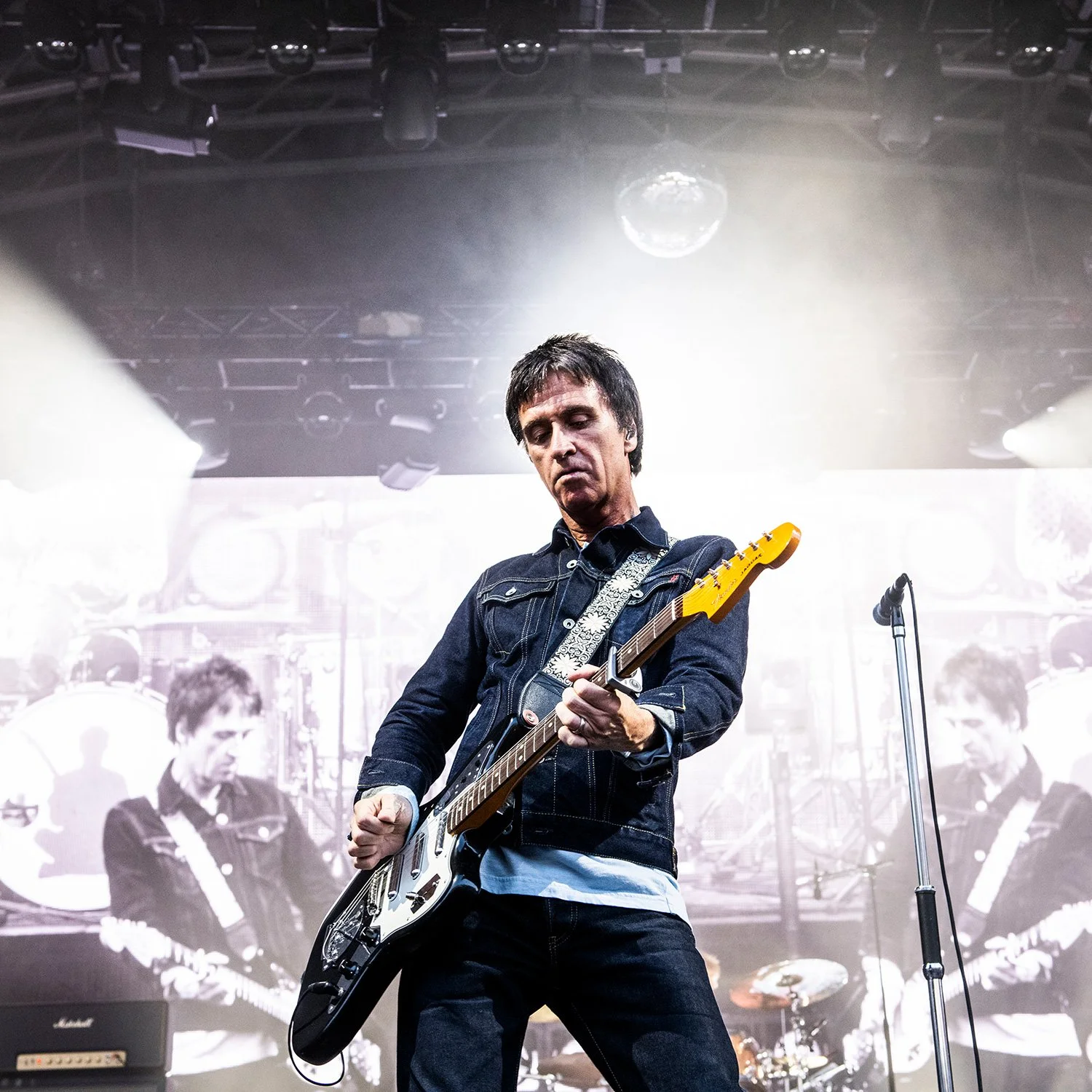
Johnny at Castlefield Bowl, Manchester. Photo by Aaron Parsons.
However, Marr’s point is that technique can only take you so far – “Craft will not write a song for you. Inspiration writes a song for you.” An important aspect of his process is setting up the best conditions for that inspiration to strike. One way of keeping it fresh is turning to favourite writers such as Joan Didion and Susan Sontag, “reading stuff that makes me interested and hopefully will make me interesting”. Another is to disrupt his own perspective on a song: when he was struggling to complete the lyrics for “Ophelia”, he sent the rest of the crew home for a week, leaving him alone in the studio. “I did this trick on myself where I played the song really loud, but I kept walking out of the room so I was hearing it down the corridor. I’d go and put the kettle on, get out of the room for four minutes, but leave it on loop really loud. Really loud. I remember when I heard the track really loud down the corridor, deliberately to try and come up with a vocal line, I just heard that line, ‘you can stop the rain’. I have no idea where that came from. You know, that wasn’t cribbed from a book or from a film; I didn’t have it in a notebook. That just fell out of the sky, because I put myself in a place where I was ready to receive some sort of divine inspiration.”
Since leaving The Smiths in 1987, Marr has worked with a diverse list of “challenging, attitude-y, intelligent artists”. One of his earliest collaborations was on the final Talking Heads album, Naked. Although aware of how prestigious it was to be invited to work with them, it wasn’t until later that he realized how significant a moment it was in his career. “I was so young, and they were one of my favourite bands, so when I was doing it, I knew it was cool, but whatever else was going on in my life at the time was maybe quite chaotic, so I just kind of rolled with it and got it done, and then was on to the next thing.” He saw David Byrne recently and they recalled their time together in the studio fondly. “From years of mythology and narrative, you might think that it was a difficult time, but not when I was working with him – it was great.” Byrne has remained an inspiration throughout Marr’s songwriting career: “You know, it’s not easy to write lyrics like, ‘I remember when sitting in the tub, pulled out the plug, the water was running out’, and make it sound really meaningful.”
Among other memorable collaborators he names are Isaac Brock of Modest Mouse, The The’s Matt Johnson, Morrissey, Hans Zimmer (with whom he worked on the score for Inception), Jenny Lee Lindberg from Warpaint, Alex Capranos from Franz Ferdinand, and Gorillaz. “All these people are really sharp, intelligent people. It’s good to be surrounded by people who really raise the bar for themselves, and therefore they expect me to match it.” Although confident of his own abilities, he knows that among such peers he can’t afford to be complacent. “Everyone I work with has a lot at stake, and it’s not just because, in Hans Zimmer’s case, Christopher Nolan is texting in to say that there’s a deadline. Everybody has their own self-imposed levels of excellence.”
Marr is clear that any successful musician has to be as hard-working as they are talented. “Noel Gallagher, despite giving the impression that he just falls out of bed and a song arrives, is a really disciplined artist. In fact, I think he’s the most disciplined person I know.” He’s also aware of the toll that his vocation can have on those around him. “If you’re going to be an artist in any way, you have to be obsessive. And sometimes obsession is not particularly healthy for you physically, mentally, and in relationships. I’m a father, and, you know, I haven’t actually missed too many birthdays, but I’ve definitely missed several anniversaries. That’s to be expected if you’re miles away, but if you’re just down the road in the studio, getting the mix of a B-side done, it does tip over into selfishness.” While Marr acknowledges how fortunate he’s been in his career – “Man, you know, you’re very lucky if you can make a living out of it, let alone be really successful and get praised for it” – he now wonders if he could moderate the obsessive single-mindedness that has made him one of the most respected artists of his generation. “But I don’t know any other way of doing it. I’m just all in.”
The Age of Everything is released 2nd October.
Author: Rachel Goodyear